If your plumbing or water heater company hasn't touched its Google Business Profile strategy in a while, it's worth five minutes of your time today.
What changed
There are two distinct updates worth knowing about, and they compound each other.
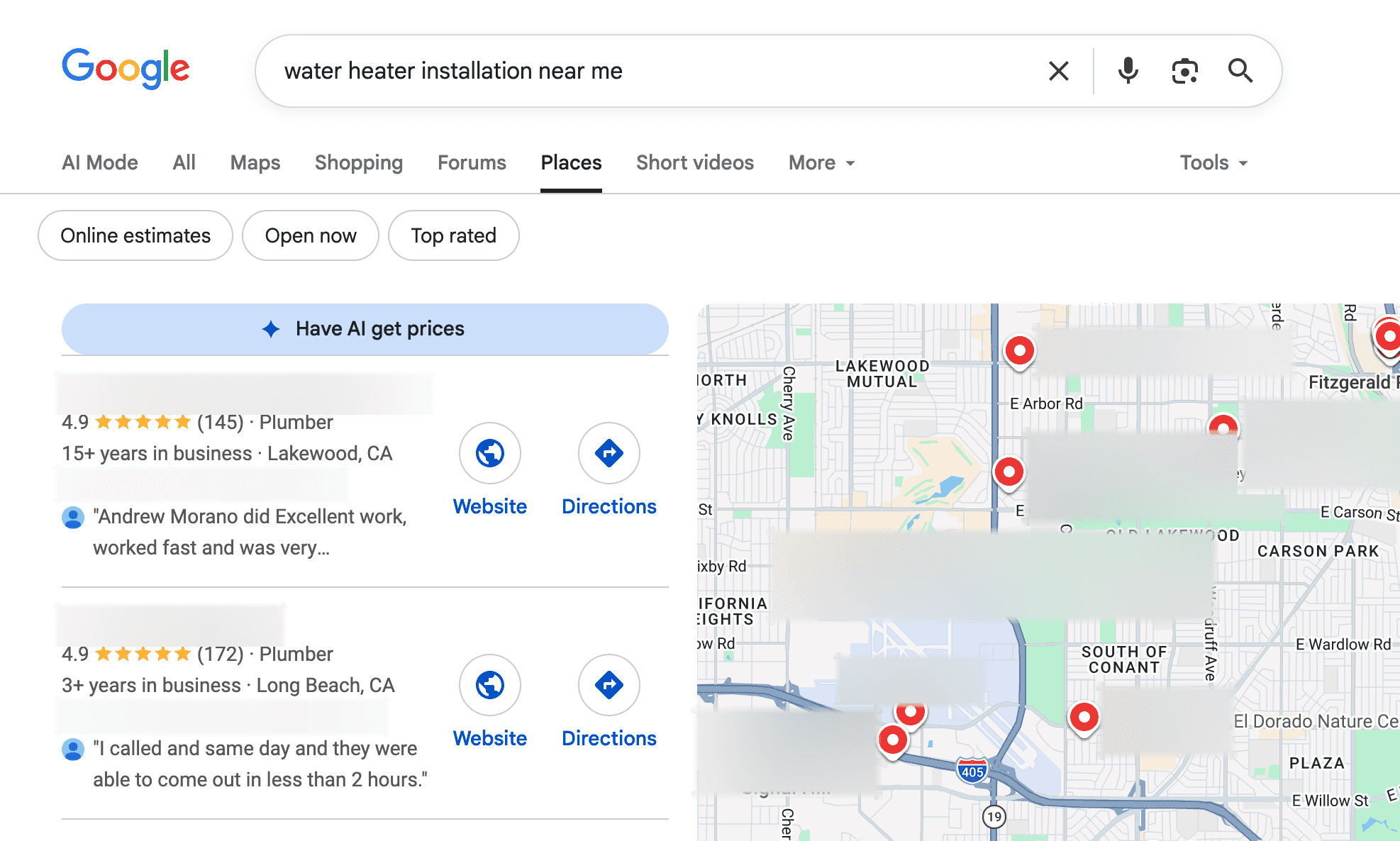
First When someone searches "water heater installation near me" or "plumber near me," Google now surfaces an "Online Estimates" filter letting homeowners narrow results to contractors offering online estimates or instant quoting tools.
Second: Google's AI now calls contractors on the homeowner's behalf to collect prices. The feature lets a homeowner describe a job, then Google's AI calls local contractors directly, asks for pricing and availability, and emails the homeowner a summary.1
Why this matters more than it sounds
It's tempting to read these as minor UI tweaks. They aren't. Here's why:
- The filter is opt-in, and homeowners are opting in. Anyone using it is self-selecting as a serious, comparison-shopping buyer — exactly the lead you want. When you're excluded from the filter, you're excluded from your best prospects.
- The AI call flips the order of operations. Historically, a homeowner called around and then compared prices. Now, Google's AI can gather and compare pricing before the homeowner even sees your brand.
- Both changes reward the same underlying thing: a fast, honest, consistent number. Whether it's a website tool a filter can detect or a phone call an AI agent can record, Google is rewarding contractors who make real pricing available quickly and penalizing the ones who make people wait.
What to do about it
You don't need to publish a full price list to benefit from this shift. You need a tool on your site that takes installation context from a homeowner and returns a real, credible estimate in seconds.
A few things worth getting right if you're building or buying this kind of tool:
- Make the pricing logic honest. A lowball number that turns into a very different final quote erodes trust fast — and shows up in reviews.
- Capture the lead at the moment of highest intent. The homeowner just told you exactly what job they want done and got a price. That's the moment to get their contact info, not before.
- Surface rebates and incentives if you install heat pump or high-efficiency units. Many homeowners don't know they qualify for meaningful rebates, and showing that math alongside your estimate is a strong differentiator — and a natural upsell into higher-margin equipment.
Don't fake it
There's a tempting shortcut here: just flip on the "Online estimates" attribute in your Google Business Profile or provide an instant quote button that results in a "fill out this form and we'll call you back within 30 minutes" page.
Years of SEO and review-building can get undone by a few weeks of bad click-through behavior. The signal isn't a person filing a complaint. It's behavioral: a homeowner clicks in expecting a price, doesn't get one, and bounces straight back to Google within seconds to keep searching. Do that enough times across enough homeowners, and Google will downgrade your ranking.
What to do next
Three concrete steps you can knock out this week, in order:
- Check your Google Business Profile → Attributes → Online estimates. Confirm it's actually turned on.
- Search for your own business like a homeowner would. Does the "Online estimates" filter even catch you? What happens after the click?
- Make sure your website delivers a real instant estimate — not a lead form in disguise. The bar is a real number based on context, in seconds, with no wait.
Why this is actually good news
Read the wrong way, all of this sounds like one more thing to keep up with. Read the right way, it's a tailwind for the contractors who move first.
Tools like VoltHub Pro Lead Gen make it a no-brainer to be a first mover: the customized pricing engine is already built, the rebate logic is already wired in, and it's live on your site in a day, not months. Plus, it's priced to scale with your growth or is free forever.2
The bottom line
Google isn't asking permission before making this change, and it isn't going to reverse it — pricing transparency has been the direction of travel in home services for years, and this filter just makes the preference explicit and actionable for consumers. The contractors who adapt now show up in searches that matter; the ones who wait get to find out what "hidden from the filter" costs them in lost jobs.
If you want to see what an instant, on-site estimate tool looks like for water heater installs — one built specifically for plumbing companies, with automatic rebate detection built in — VoltHub Pro Lead Gen is worth a look.
Sources
- Google Search Help, "How to check pricing for local businesses with AI in Google Search" — official Google documentation
- VoltHub Pro Pricing, "Pricing that scales with your growth or is free forever"